The EcoRRAP R&D Subprogram fills key knowledge gaps essential for the success and cost-effectiveness of reef restoration interventions.
An integrated field program, EcoRRAP provides data on region-, temperature- and species-specific coral life-histories. It quantifies natural rates of recovery and adaptation in response to global and local changes, as well as rates of recovery in response to interventions.
The central objective is to optimise interventions by understanding the ‘how, where, and when’ of natural reef recovery. This foundational data will help inform assumptions and decisions across the whole of RRAP and enable the success and cost-effectiveness of intervention research and development.
Alongside subprogram management and coordination, this project is focused on the establishment and long-term monitoring of Reference Reef sites across the length and breadth of the Reef. The Reference Reef sites provide critical baseline data sets to support RRAP decision makers in determining the how, why, and where of intervention deployment.
This project will generate knowledge on the important traits driving natural recovery and adaptation to both disturbances like heat stress and to restoration interventions. The project will investigate the variation of these traits across space, time, environments, and species.
This project aims to inform coral restoration planning by identifying agents of mortality for juvenile corals and how these vary in relation to environmental and ecological interactions, as well as defining the ideal size and density of adult corals to overcome reproduction bottlenecks and support larval production to optimise natural recovery.
Ferrari, R., Lachs, L., Pygas, D. R., Humanes, A., Sommer, B., Figueira, W. F., Edwards, A. J., Bythell, J. C., & Guest, J. R. (2021). Photogrammetry as a tool to improve ecosystem restoration. Trends in Ecology & Evolution, 36(12), 1093–1101. https://doi.org/10.1016/j.tree.2021.07.004
Riginos, C., & Beger, M. (2021). Incorporating genetic measures of connectivity and adaptation in marine spatial planning for corals. In C. R. Voolstra & R. B. Ramos (Eds.), Coral reef conservation and restoration in the omics age (pp. 15–35). Springer. Incorporating Genetic Measures of Connectivity and Adaptation in Marine Spatial Planning for Corals | SpringerLink
Lachs, L., Humanes, A., Pygas, D. R., Bythell, J. C., Mumby, P. J., Ferrari, R., Figueira, W. F., Beauchamp, E., East, H. K., Edwards, A. J., Golbuu, Y., Martinez, H. M., Sommer, B., van der Steeg, E., & Guest, J. R. (2023). No apparent trade-offs associated with heat tolerance in a reef-building coral. Communications Biology, 6, Article 400. https://doi.org/10.1038/s42003-023-04758-6
Meziere, Z., Popovic, I., Prata, K., Ryan, I., Pandolfi, J., & Riginos, C. (2024). Exploring coral speciation: Multiple sympatric Stylophora pistillata taxa along a divergence continuum on the Great Barrier Reef. Evolutionary Applications, 17(1), e13644. https://doi.org/10.1111/eva.13644
Buccheri, E., Ricardo, G. F., Babcock, R. C., Mumby, P. J., & Doropoulos, C. (2023). Fertilisation kinetics among common Indo-Pacific broadcast spawning corals with distinct and shared functional traits. Coral Reefs, 42(6), 1351–1363. https://doi.org/10.1007/s00338-023-02431-2
Álvarez-Noriega, M., Marrable, I., Noonan, S. H. C., Barneche, D. R., & Ortiz, J. C. (2023). Highly conserved thermal performance strategies may limit adaptive potential in corals. Proceedings of the Royal Society B: Biological Sciences, 290(1994), 20221703. https://doi.org/10.1098/rspb.2022.1703
Fabricius, K. E., Crossman, K., Jonker, M., Mongin, M., & Thompson, A. (2023). Macroalgal cover on coral reefs: Spatial and environmental predictors, and decadal trends in the Great Barrier Reef. PLOS ONE, 18(1), Article e0279699. https://doi.org/10.1371/journal.pone.0279699
Richards, T. J., McGuigan, K., Aguirre, J. D., Humanes, A., Bozec, Y.-M., Mumby, P. J., & Riginos, C. (2023). Moving beyond heritability in the search for coral adaptive potential. Global Change Biology, 29(6), 1569–1581. https://doi.org/10.1111/gcb.16719x
Wolfe, K. M., Boström‐Einarsson, L., McLeod, I. M., & Suggett, D. J. (2023). Hidden biodiversity in coral rubble: A hierarchical structuring approach reveals the value of microhabitats for reef restoration. Ecological Monographs, 93(3), Article e1586. https://doi.org/10.1002/ecm.1586
Burgo, M., & Hoey, A. (2024). The Changing Focus of Coral-Macrophyte Interactions: A Review of Four Decades of Research. In P. A. Todd & B. D. Russell (Eds.), Oceanography and Marine Biology: An Annual Review (pp. 267–302). CRC Press. https://doi.org/10.1201/9781003477518-7
Remmers, T., Grech, A., Roelfsema, C., Gordon, S., Lechene, M., & Ferrari, R. (2024). Close-range underwater photogrammetry for coral reef ecology: A systematic literature review. Coral Reefs, 43(1), 35–52. https://doi.org/10.1007/s00338-023-02445-w
Lechene, M. A. A., Figueira, W. F., Murray, N. J., Aston, E. A., Gordon, S. E., & Ferrari, R. (2024). Evaluating error sources to improve precision in the co-registration of underwater 3D models. Ecological Informatics, 81, 102632. https://doi.org/10.1016/j.ecoinf.2024.102632
Webber, K., Fabricius, K., Wilson, S. K., & Hoey, A. S. (2024). The influence of Sargassum biomass and thallus density on the recruitment of coral reef fishes. Coral Reefs, 43, 687–699. https://doi.org/10.1007/s00338-024-02494-9
Fabricius, K. E., Cooley, S. R., Golbuu, Y., Riginos, C., Gonzalez-Rivero, M., Heron, S. F., Mead, D., Cinner, J., & Schaffelke, B. (2024). Research priorities to support coral reefs during rapid climate change. PLOS Climate, 3(7), e0000435. https://doi.org/10.1371/journal.pclm.0000435
Martin, C. C., McClure, E. C., Webber, K., Burgo, M., & Hoey, A. S. (2024). Utilisation of macroalgal habitats by juvenile rabbitfishes on an inshore reef. Coral Reefs, 43, 1843–1855. https://doi.org/10.1007/s00338-024-02581-x
Álvarez-Noriega, M., Ortiz, J. C., Ceccarelli, D. M., Emslie, M. J., Fabricius, K. E., Jonker, M. J., Puotinen, M., Robson, B. J., Roelfsema, C. M., Sinclair-Taylor, T. H., & Ferrari, R. (2025). Spatial variation in upper limits of coral cover on the Great Barrier Reef. Global Ecology and Biogeography, 34(1), e13928. https://doi.org/10.1111/geb.13928
Riginos, C., Popovic, I., Meziere, Z., Garcia, V., Byrne, I., Howitt, S. M., Ishida, H., Bairos-Novak, K., Humanes, A., Scharfenstein, H., Richards, T., Briggs, E., Clark, V., Lei, C., Khan, M., & Prata, K. E. (2024). Cryptic species and hybridisation in corals: Challenges and opportunities for conservation and restoration. Peer Community Journal, 4, e106. https://doi.org/10.24072/pcjournal.492
Remmers, T., Boutros, N., Wyatt, M., Gordon, S., Toor, T., Roelfsema, C., Fabricius, K., Grech, A., Lechene, M. A. A., & Ferrari, R. (2025). RapidBenthos: Automated segmentation and multi-view classification of coral reef communities from photogrammetric reconstruction. Methods in Ecology and Evolution, 16(2), 427–441. https://doi.org/10.1111/2041-210X.14477
P.J. Mumby, G. Sartori, E. Buccheri, C. Alessi, H. Allan, C. Doropoulos, G. Rengiil, & G. Ricardo, Allee effects limit coral fertilization success, Proc. Natl. Acad. Sci. U.S.A. 121 (52) e2418314121, https://doi.org/10.1073/pnas.2418314121 (2024)
Álvarez-Noriega, M., Aston, E., Becker, M., Fabricius, K. E., Figueira, W. F., Gordon, S., Krensel, R., Lechene, M. A. A., Remmers, T., Toor, M., & Ferrari, R. (2025). Challenging paradigms around the role of colony size, taxa, and environment on bleaching susceptibility. Global Change Biology, 31(2), e70090. https://doi.org/10.1111/gcb.70090
Drake, M. A., Noonan, S. H. C., Alvarez-Noriega, M., Rashid, A. R., & Fabricius, K. E. (2025). Current velocity, water quality, and benthic taxa as predictors for coral recruitment rates on the Great Barrier Reef. PLOS ONE, 20(3), e0319521. https://doi.org/10.1371/journal.pone.0319521
Matias, A. M. A., Popovic, I., Thia, J. A., Cooke, I. R., Torda, G., Lukoschek, V., Bay, L. K., Kim, S. W., & Riginos, C. (2023). Cryptic diversity and spatial genetic variation in the coral Acropora tenuis and its endosymbionts across the Great Barrier Reef. Evolutionary Applications, 16(2), 293–310. https://doi.org/10.1111/eva.13435
Briggs, N. D., Page, C. A., Giuliano, C., Alessi, C., Hoogenboom, M., Bay, L. K., & Randall, C. J. (2024). Dissecting coral recovery: Bleaching reduces reproductive output in Acropora millepora. Coral Reefs, 43(3), 557–569. https://doi.org/10.1007/s00338-024-02483-y
Ani, C. J., Haller-Bull, V., Gilmour, J. P., & Robson, B. J. (2024). Connectivity modelling identifies sources and sinks of coral recruitment within reef clusters. Scientific Reports, 14, Article 13564. https://doi.org/10.1038/s41598-024-64388-8
Sun, C., Steinberg, C., Klein Salas, E., Mellin, C., Babcock, R. C., Schiller, A., Cantin, N. E., Stella, J. S., Baird, M. E., Condie, S. A., Hobday, A. J., Herzfeld, M., Jones, N. L., Zhang, X., Chamberlain, M. A., Fiedler, R., Green, C., & Steven, A. D. L. (2024). Climate refugia in the Great Barrier Reef may endure into the future. Science Advances, 10(48), eado6884. https://doi.org/10.1126/sciadv.ado6884
Hsu, T.-H. T., Gordon, S., Ferrari, R., Hoey, A. S., & Figueira, W. F. (2025). Optimizing remote underwater video sampling to quantify relative abundance, richness, and corallivory rates of reef fish. Coral Reefs, 44, 435–449. https://doi.org/10.1007/s00338-024-02613-6
Aston, E. A., Duce, S., Hoey, A. S., & Ferrari, R. (2022). A protocol for extracting structural metrics from 3D reconstructions of corals. Frontiers in Marine Science, 9, 854395. https://doi.org/10.3389/fmars.2022.854395
Ferrari, R., Leon, J. X., Davies, A. J., Burns, J. H. R., Sandin, S. A., Figueira, W. F., & Gonzalez-Rivero, M. (2022). Editorial: Advances in 3D habitat mapping of marine ecosystem ecology and conservation. Frontiers in Marine Science, 8, 827430. https://doi.org/10.3389/fmars.2021.827430
Guillaume, A. S., Ferrari, R., Selmoni, O., Mocellin, V. J. L., Denis, H., Naugle, M., Howells, E., Bay, L. K., & Joost, S. (2025). Harnessing multiscale topographic environmental variables for regional coral species distribution models. Ecology and Evolution, 15(4), e71292. https://doi.org/10.1002/ece3.71292
Ricardo, G. F., Doropoulos, C., Babcock, R. C., Adam, A. A. S., Buccheri, E., Robledo, N., Uribe-Palomino, J., & Mumby, P. J. (2025). Spawning asynchrony and mixed reproductive strategies in a common mass spawning coral. Ecology and Evolution, 15, e71654. https://doi.org/10.1002/ece3.71654
Burgo, M., Fabricius, K. E., & Hoey, A. S. (2025). The structure and composition of macroalgal communities influence coral recruitment on an inshore reef of the Great Barrier Reef. Coral Reefs, 44, 1315–1326. https://doi.org/10.1007/s00338-025-02691-0
Meziere, Z., Prata, K., Lechene, M., Ferrari, R., Popović, I., & Riginos, C. (2025). Connectivity differs by orders of magnitude among co-distributed corals, affecting spatial scales of eco-evolutionary processes. Science Advances, 11(27), eadt2066. https://doi.org/10.1126/sciadv.adt2066
Greenwood, J., Sun, C. J., Doropoulos, C., Thomson, D., Baird, M., Porobic, J., & Condie, S. (2025). Passive retention of simulated larvae on coral reefs. Royal Society Open Science, 12(5). https://doi.org/10.1098/rsos.241708
Doropoulos, C., Alvarez-Noriega, M., Fabricius, K. et al. Impact of environmental gradients on juvenile coral demography across the Great Barrier Reef and Torres Strait. Coral Reefs 44, 1875–1891 (2025). https://doi.org/10.1007/s00338-025-02742-6
Cheung, M. W. M., McWilliams, J., & van Woesik, R. (2025). Moving beyond temperature metrics in coral bleaching: The role of environmental context on bleaching responses. Global Ecology and Biogeography. Advance online publication. https://doi.org/10.1111/geb.70105
Ricardo, G., Doropoulos, C., Babcock, R.C. et al. Critical thresholds of adult patch density and spacing during coral fertilization. Nat Ecol Evol 9, 2092–2102 (2025). https://doi.org/10.1038/s41559-025-02844-y
Pisapia, C., Burn, D., Hoey, A.S. et al. Coral recovery versus reassembly following major disturbances in the Central Maldivian Archipelago. Coral Reefs (2025). https://doi.org/10.1007/s00338-025-02780-0
Webber, K., Fabricius, K., Wilson, S. K., Konovalov, D. A., Winding, N., & Hoey, A. S. (2025). Canapes in the canopy: Canopy macroalgae are dining hotspots for small and juvenile fishes at Orpheus Island, Great Barrier Reef. Marine Environmental Research, 212, Article 107490. https://doi.org/10.1016/j.marenvres.2025.107490
Burn, D., et al. (2025). Keystone coral species population collapse after unprecedented heat stress. Trends in Ecology & Evolution, 40(12), 1164–1166. https://doi.org/10.1016/j.tree.2025.10.006
Humanes, A., Fabricius, K. E., Ferrari, R., & Ortiz, J. C. (2025). Ecological quantitative criteria for reef site prioritisation to maximise survivorship and growth of outplanted corals. Journal of Environmental Management, 392, 126585. https://doi.org/10.1016/j.jenvman.2025.126585
Overview and In-Field Workflow
Digitisation and 2D metric extraction
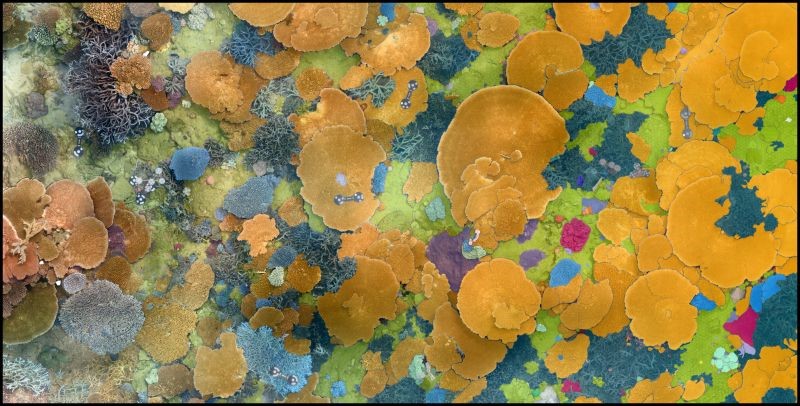
Tracking Reef Recovery: Explore 5 Years of Change in 3D
An interactive resource using high-resolution photogrammetry to show how coral communities have changed over time across multiple reef sites.
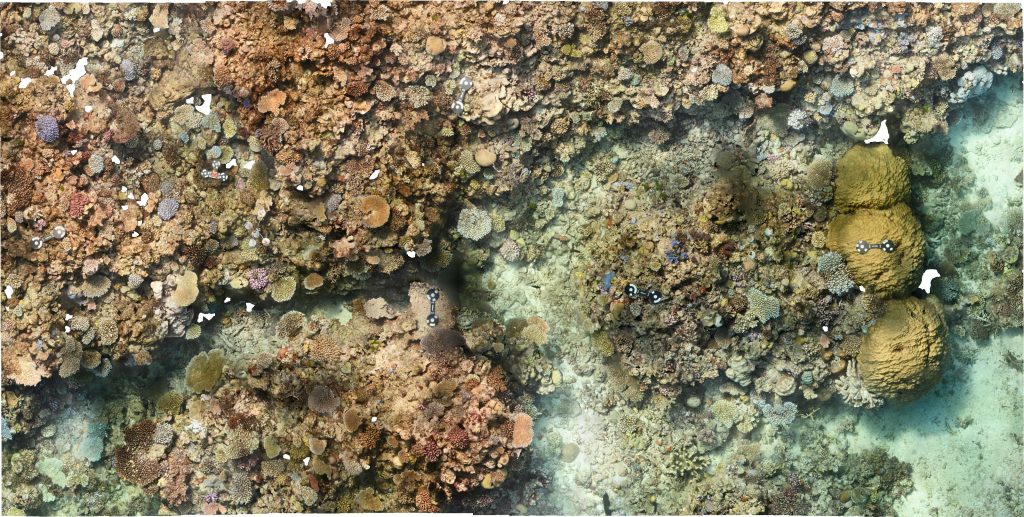
3D models produced using photogrammetry.
3D Imagery of the growth, recovery and survival of corals over time, provides vital information to support restoration efforts.

Peter Mumby
Professor
UQ
Manuel Gonzalez-Rivero
Research Scientist
AIMS
John Luetchford
Oceanographic Technician
AIMS

Pascal Craw
Research Scientist
CSIRO

Robert Mason
Research Scientist
CSIRO
Frank Coman
Research Assistant
CSIRO
Sam Noonan
Research Assistant
AIMS
Browyn Holmes
Research Assistant
CSIRO
Morane Le Nohaic
PhD Candidate
UQ and CSIRO
Hannah Allan
PhD Candidate
UQ
Elizabeth Buccheri
PhD Candidate
UQ
Isabella Marrable
AIMS and Uni. of Sydney
Sophie Gordon
Research Assistant
AIMS
Devin Rowell
PhD Candidate
UQ
Kelsey Webbe
PhD Candidate
JCU