Coral restoration using larval seeding aims to speed the return of coral cover, diversity and complexity to damaged reefs. It does this by increasing the number of coral larvae available for settlement and growth into new corals, particularly where reefs have low larval supply (e.g. following largescale bleaching that can kill many breeding corals).
The RRAP Moving Corals R&D Subprogram was part of RRAP’s first R&D phase and aimed to develop the means to cost-effectively produce billions of genetically-diverse coral larvae with enhanced environmental tolerance for large-scale restoration. Larvae were harvested from wild coral-spawn slicks, cultured in floating nurseries, and transferred for settlement to reef areas to catalyse coral restoration, adaptation and reef recovery.
that efficiently capture wild coral-spawn slicks in common reef- and weather-dependent scenarios
to enhance their survival and growth
that provide scalable targeted transfer of larvae onto reefs through direct application or via settlement on devices
of naturally more thermally-tolerant larvae to facilitate reef recovery following coral bleaching.
Moving Corals expanded current smaller-scale methods of spawn and slick capture and larval rearing to develop and test large-scale routine production and transfer of hundreds of millions to billions of larvae at sea. The aim was to achieve targeted delivery and settlement to reefs with low coral cover over multi-kilometre scales.
The subprogram aimed to enhance the effectiveness of coral larvae collection, cultivation and deployment – developing different aspects of collection and transfer, experimental treatments of larvae and deployment and monitoring techniques.
Variations were tested in the field at spawning, and refinements applied following field trials, progressively increasing the scaling, mechanisation of the intervention.
These outcomes have enabled future implementation of routine, reef-scale larval restoration over multiple high-value ‘source’ reefs in different regions by stakeholders.
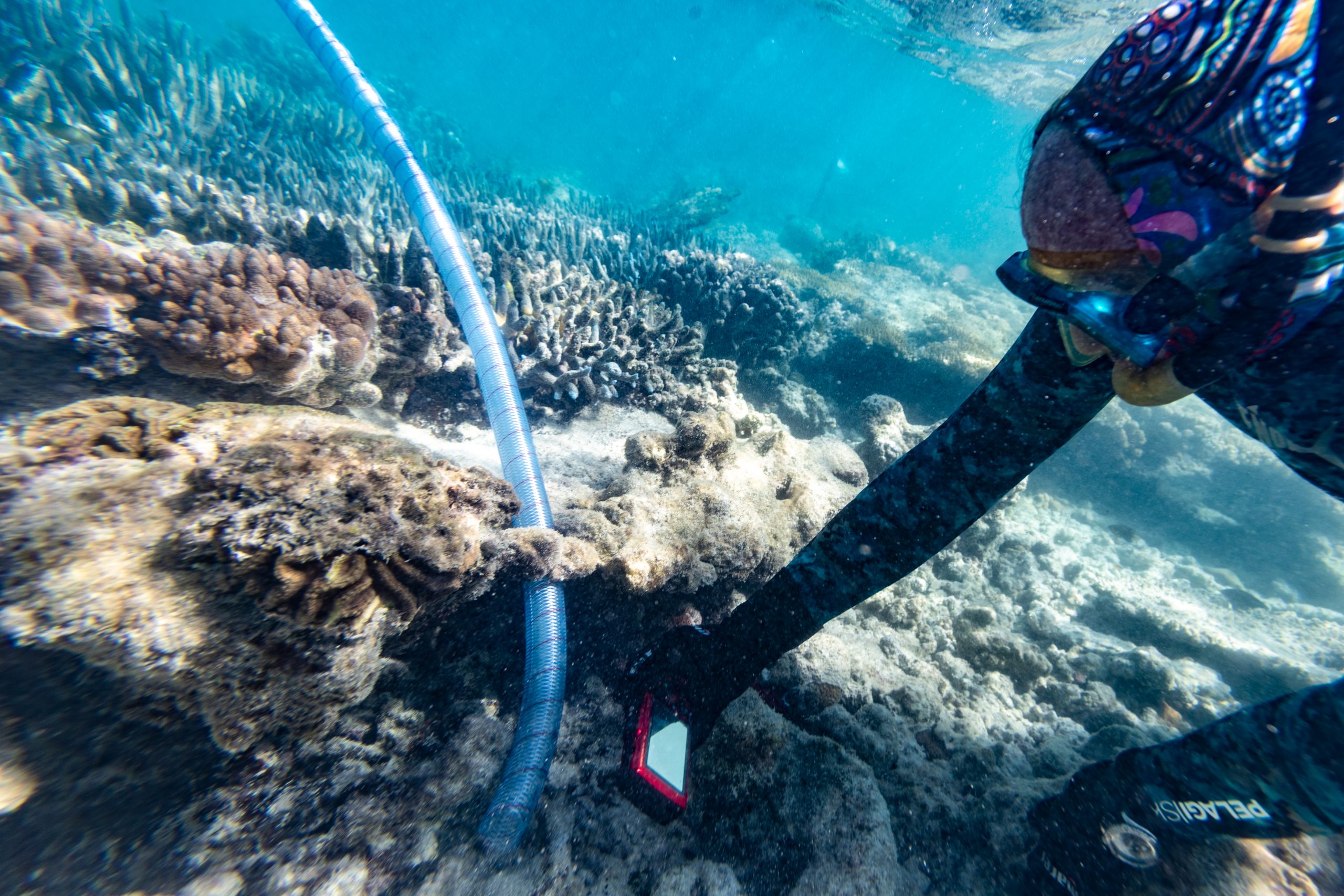
Seeding larvae onto degraded reef areas Photo: SCU
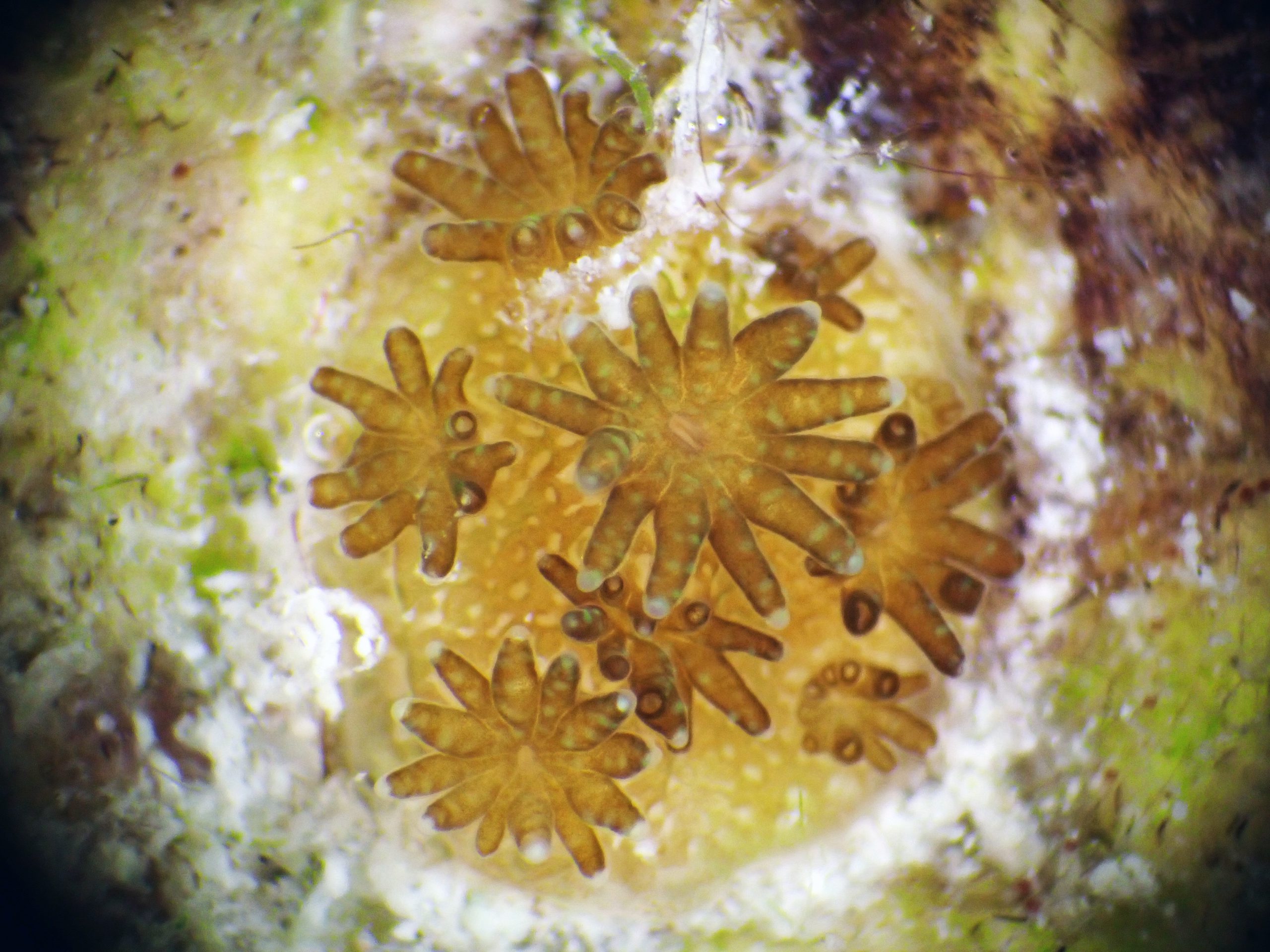
Six-week old coral juvenile after larval seeding onto reef Photo: Peter Harrison
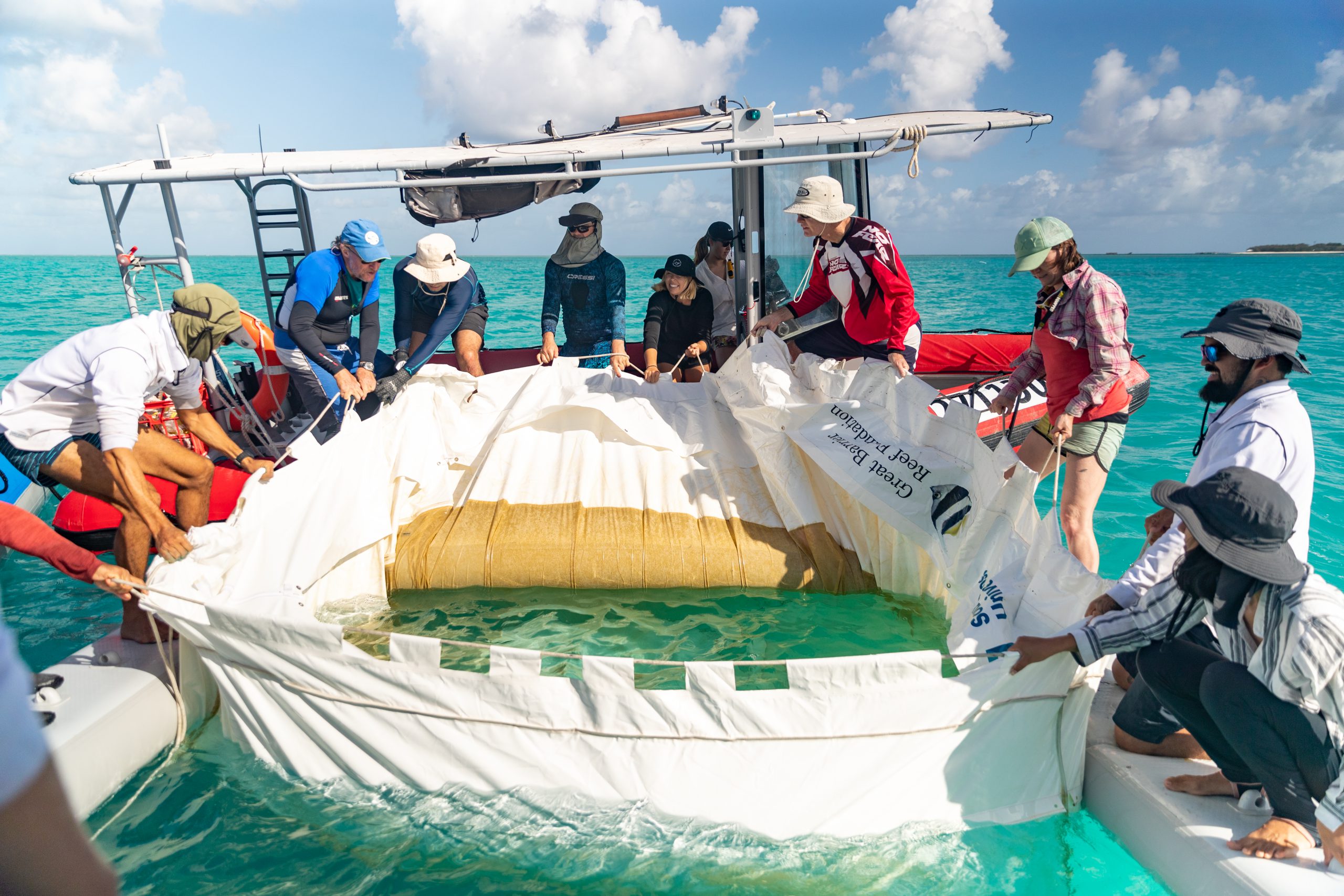
Concentrating coral larvae in a culture net for release onto sections of damaged reef. Photo: SCU
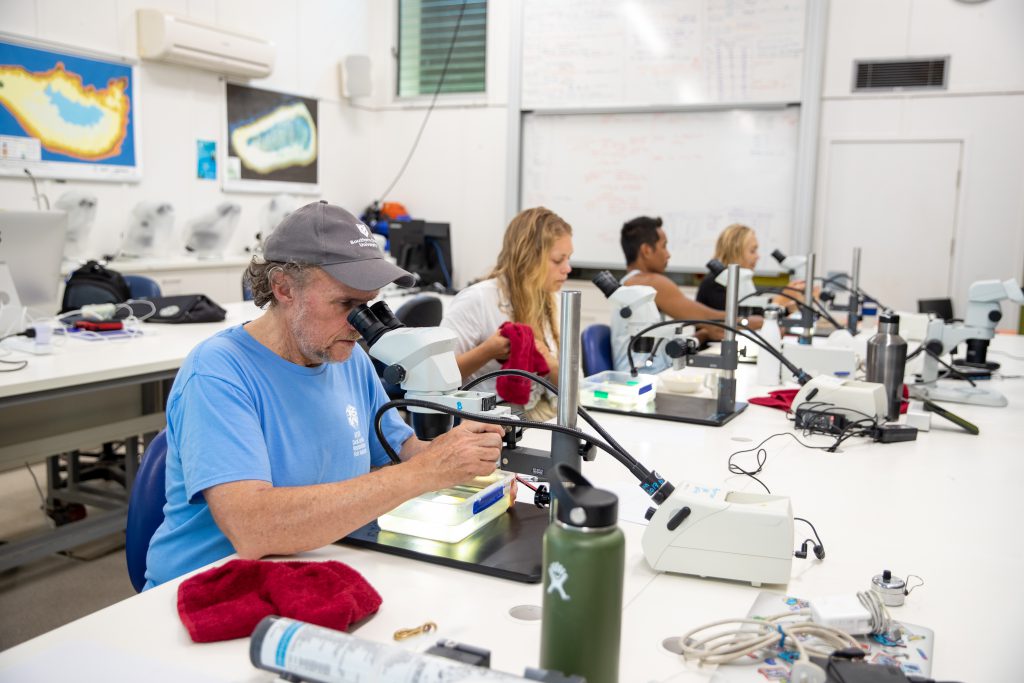
This project expanded current smaller-scale spawn and slick capture and larval rearing methods to develop and test larger-scale routine production and transfer of larvae for restoration of high-value reefs.
Doropoulos, C., & Roff, G. (2022). Coloring coral larvae allows tracking of local dispersal and settlement. PLOS Biology, 20(12), e3001907. https://doi.org/10.1371/journal.pbio.3001907
Doropoulos, C., & Vanderklift, M. A. (2022). Harvesting coral spawn slicks for reef restoration. In S. M. Hamylton, P. Hutchings, & O. Hoegh-Guldberg (Eds.), Coral reefs of Australia: Perspectives from beyond the water’s edge (pp. 273–279). CSIRO Publishing. https://doi.org/10.1071/9781486315499
Gouezo, M., Doropoulos, C., Slawinski, D., Cummings, B., & Harrison, P. (2023). Underwater macrophotogrammetry to monitor in situ benthic communities at submillimetre scale. Methods in Ecology and Evolution, 14(9), 2494–2509. https://doi.org/10.1111/2041-210X.14175
Langley, C., Harrison, P. L., & Doropoulos, C. (2024). Optimizing initial stocking densities of wild coral spawn slicks for mass production of larvae and settled corals for restoration. Restoration Ecology, 32(7), e14239. https://doi.org/10.1111/rec.14239
Waters, C., Harrison, P. L., Gouezo, M., Severati, A., & Doropoulos, C. (2025). Early-stage coral survivorship using wild larval assemblages on coral seeding devices for reef restoration. Restoration Ecology, 33(3), e14387. https://doi.org/10.1111/rec.14387
Gouezo, M., Langlais, C., Beardsley, J., Roff, G., Harrison, P. L., Thomson, D. P., & Doropoulos, C. (2025). Going with the flow: Leveraging reef-scale hydrodynamics for upscaling larval-based restoration. Ecological Applications, 35(3), e70020. https://doi.org/10.1002/eap.70020
Harrison, P. L. (2024). Sexual reproduction of reef corals and application to coral restoration. In Oceanographic processes of coral reefs (2nd ed., pp. 19). CRC Press. https://doi.org/10.1201/9781003320425-32
Doropoulos, C., Roff, G., Carlin, G., Gouezo, M., Dela Cruz, D., Chai, A., Hardiman, L., Hasson, L., Thomson, D. P., & Harrison, P. L. (2025). Larval seedboxes: A modular and effective tool for scaling coral reef restoration. Ecological Applications, 35(7), e70140. https://doi.org/10.1002/eap.70140
Mason, R. A. B., Langlais, C., Uribe-Palomino, J., Tonks, M. L., et al. (2025). Reef-scale variation in larval supply and settlement: Validating Lagrangian dispersal predictions with observations of coral larvae. Estuarine, Coastal and Shelf Science, 326, 109506. https://doi.org/10.1016/j.ecss.2025.109506
Gouezo, M., Roff, G., Carlin, G., Doropoulos, C., Dela Cruz, D., Chai, A., Hardiman, L., Hasson, L., Thomson, D. P., & Harrison, P. L. (2025). Coral larval enhancement with and without nets yields similar recruitment during slack-current releases. Restoration Ecology. Advance online publication. https://doi.org/10.1111/rec.70219
Langley, C., Doropoulos, C., dela Cruz, D., & Harrison, P. L. (2025). Effects of shading aquaculture pools on coral larvae health and production. Aquaculture, 609, 742953. https://doi.org/10.1016/j.aquaculture.2025.742953
Langley C, Doropoulos C, dela Cruz D, Harrison PL (2025) Scaling up coral spawn collection: Impacts of method and timing on Acropora valida larval quality. PLoS One 20(9): e0331461. https://doi.org/10.1371/journal.pone.0331461
Waters, C. (2025). Developing and scaling settlement, deployment and monitoring of wild cultured larvae for reef restoration [Doctoral dissertation, Southern Cross University]. Southern Cross University Repository. https://doi.org/10.25918/thesis.505
Langley, C. (2025). Optimising mass culturing of coral larvae from wild coral spawn: Enhancing survival and production for scalable reef restoration [Doctoral dissertation, Southern Cross University]. Southern Cross University Repository. https://doi.org/10.25918/thesis.527
Harrison, P.L.*, Doropoulos, C.*, Gouezo, M., Roff, G., Carlin, G., dela Cruz, D., Langlais, C., Beardsley, J., Forcey, K. (2025) Reef Restoration and Adaptation Program – Moving Corals Reef-based Coral Larval Restoration – Standard Operating Procedure. (pp. 95).
Doropoulos, C.*, Harrison, P. L.*, Gouezo, M., Roff, G., Langley, C., Waters, C., Carlin, G., dela Cruz, D., Hardiman, L., Thomson, D. P., Donovan, A., Millist, Y., Langlais, C., and Beardsley, J. (2025) Reef Restoration and Adaptation Program – Larval Collection, Culture, Deployment, Translocation (MC-01) Final Report 2025. (36 pp).
| Title | Conference | Date |
|---|---|---|
| Large scale reef restoration | Parks Australia National Science Forum conference webinar | 2021 |
| Optimising larval supply & recruitment for corals and reef restoration (Including MC RRAP work) | 14th International Coral Reef Symposium (ICRS), Bremen, Germany | 2021 |
| Optimising mass larval supply and recruitment for successful coral and reef restoration | Reef Futures Symposium, Florida, United States of America | 2021 |
| An overview of EcoRRAP and Moving Corals: two RRAP subprograms tackling ecological thresholds and larval propagation | Oceans & Atmosphere Advisory Group, Brisbane, Australia | 2022 |
| Applications of a high-resolution hydrodynamic model and particle tracking to facilitate coral restoration around Lizard Island, QLD | IMOS 2022 Forum for Operational Oceanography (FOO)/Australian Ocean and Coastal Modelling and Observations (ACOMO) Workshop, Fremantle, Australia | 2022 |
| Colouring coral larvae for tracking mass larval deployments for reef restoration | Australian Marine Sciences Association (AMSA) Conference, Cairns, Australia | 2022 |
| Mass Coral Larval Production + Supply for Large Scale Coral and Reef Restoration (Including MC RRAP work) | 14th International Coral Reef Symposium (ICRS), Bremen, Germany | 2022 |
| More Sex on the Reef for Reef Restoration (Including MC RRAP work) | AIMS NCP workshop | 2022 |
| Optimising collection, culture, and deployment of wild coral spawn slicks on the northern Great Barrier Reef | Reef Futures Symposium, Key Largo, United States of America | 2022 |
| Optimising stocking densities of wild coral spawn slicks to mass culture larvae for reef restoration | Australian Coral Reef Society (ACRS) Conference, Brisbane, Australia | 2022 |
| Port development in tropical Australia: sensitivities and scaling coral restoration | Ports and Waterways International Symposium | 2022 |
| Reconfigurable Robots for Scaling Reef Restoration | 14th International Coral Reef Symposium (ICRS), Bremen, Germany | 2022 |
| Scaling up Coral Larval Production in Reef Pools for Increasing Settlement and Recruitment Success | Australian Marine Sciences Association (AMSA) Conference, Cairns, Australia | 2022 |
| The use of coral larvae for reef restoration | Australia-Sri Lanka Blue Carbon Fellows | 2022 |
| Optimising stocking densities of wild coral spawn slicks for mass production of larvae and settled corals for restoration | Asia Pacific Coral Reef Symposium (APCRS), NUS, Singapore | 2023 |
| Scaling up coral reef restoration using larval propagules: integration across social, ecological, and operational processes (Keynote) | Australian Marine Sciences Association (AMSA) Conference, Gold Coast, Australia | 2023 |
| Testing a fine-scale biophysical model to forecast the dispersal of coral larvae for reef restoration | Asia Pacific Coral Reef Symposium (APCRS), Nus, Singapore | 2023 |
| Larger scale reef-based slick collection, culturing, and deployment of coral larvae from wild coral spawn slicks for reef restoration | Reef Resilience Symposium, Cairns, Australia | 2024 |
| Predicting coral spawn slicks and dispersal of coral larvae to inform larval-based restoration interventions | Reef Resilience Symposium, Cairns, Australia | 2024 |
Christina Langley
SCU