
In 2019, Reef Traditional Owners identified a clear need for a tool to support informed decision-making about emerging reef restoration and adaptation activities happening on Sea Country. The Biocultural Risk and Opportunity Assessment Framework has emerged to address this need.
It has been created by and for Reef Traditional Owners through collaborative workshops over a period of five years. It developed from the Biocultural risk and opportunity assessment project, of the Stakeholder and Traditional Owner Engagement Sub-Program, led by a team comprised key members of the AIMS Indigenous Partnerships team, social scientists from CSIRO and with support and guidance from the Traditional Owner Technical Working Group for Reef Restoration and Adaptation Science and Crown of Thorns Starfish. It was collaboratively developed via 3 workshops held with a total of 15 Traditional Owner groups from the northern, middle and southern parts of the Great Barrier Reef who were already involved with RRAP, and a further two workshops held each with Lama Lama People and the Deadly Reef Ecological Adaptation Murri Scientists (DREAMS) team to test and improve the Framework.
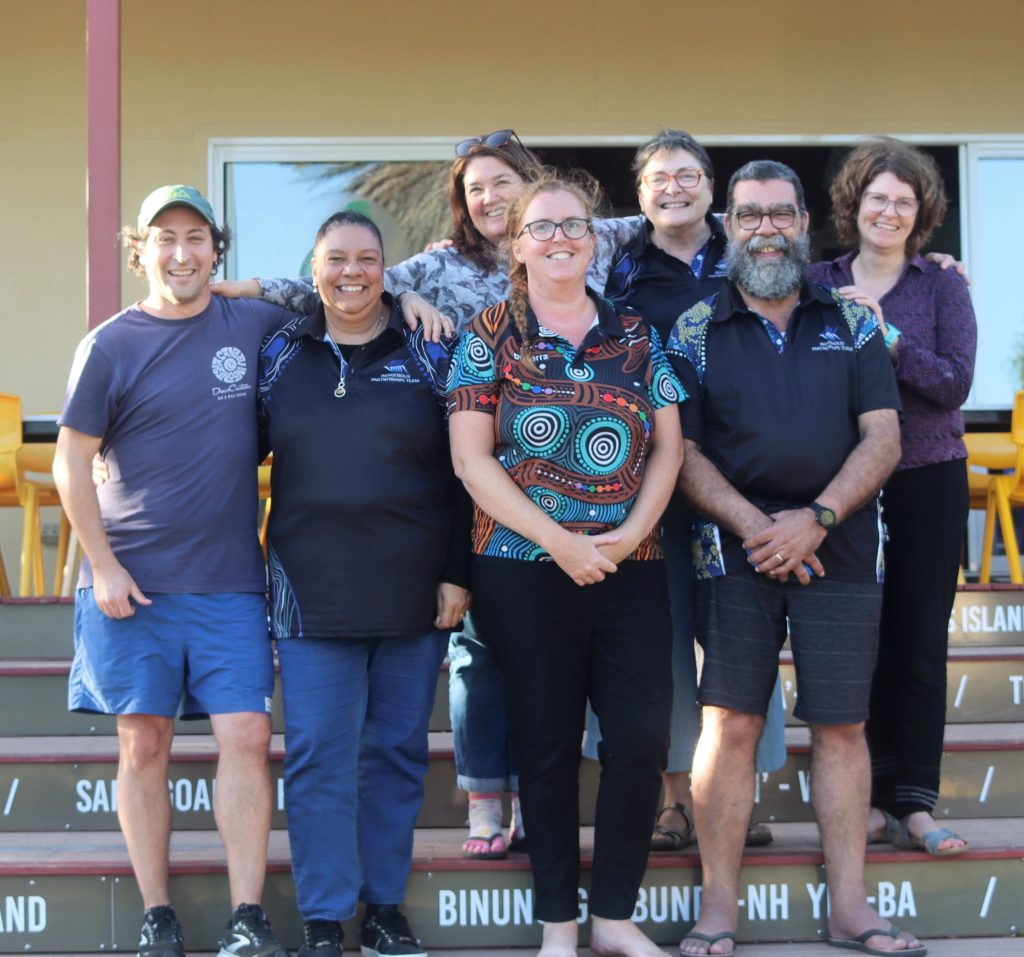
Members of the project team, Konomie, 2023 (L-R: Bruce Taylor, Manuwuri Forester, Cath Moran, Kelli Schmitt, Libby Evans-Illidge, Bob Muir, Kirsten Maclean, not pictured: Carl Grant, Dion Devow, Peci Lyons). Credit: Kelli Schmitt (CSIRO)
The Framework provides protocol and principles to guide culturally grounded conversations to support decision-making within and between Traditional Owner groups.
A strengths-based approach is central, recognising Traditional Owners not simply as risk managers for research projects, but as active partners who will shape positive futures for Land and Sea Country. This is reflected in the guided discussion themes, which include connecting people to Country, protecting Indigenous Cultural and Intellectual Property, and building long-term capacity.
The Framework has been designed so that it is transferable and adaptable to other research and development contexts. As per the legal deed of assignment of copyright, this Framework is held on behalf of Traditional Owners of the Great Barrier Reef by the Australian Institute of Marine Science, pending further assignment to a future legal entity representing Traditional Owners of the Great Barrier Reef.
The intention of the Framework is to promote meaningful, early and ongoing collaboration with Traditional Owners in proposals relating to the Great Barrier Reef. Any use of the Framework without engaging with Traditional Owners falls short of ethical research standards and industry practice.
It is important to note and as per the deed of assignment of copyright:
More information about the project and Framework can be found in the Summary Report.
As part of the Biocultural Assessment project, the project team and workshop participants have also developed a guidance for prospective partners on engaging in meaningful, culturally respectful discussions about potential RRAP technology deployments. This information supports genuine partnership and consent, not persuasion, ensuring that Traditional Owners’ rights, knowledge, and decisions remain central to all activities on Sea Country.