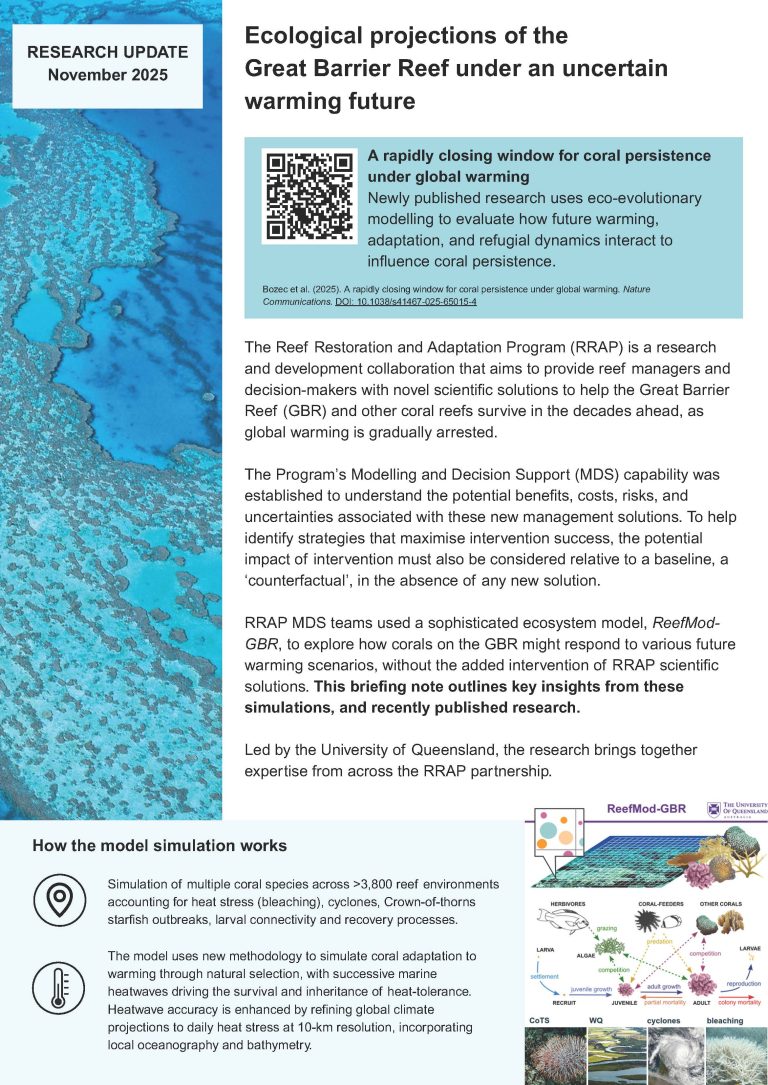
Ecological Projections of the Great Barrier Reef under an uncertain future.
The Modelling and Decision Support Subprogram was part of RRAP’s first R&D phase and aimed to enable Reef restoration and adaptation decision-makers in making and communicating the highest quality decisions to guide investment and action.
As the Program’s various intervention technologies were researched and developed, the levels of restoration, adaptation or protection potential, and the levels of cost involved were subject to uncertainty and prediction. The potential of interventions is their future ability to protect, restore or help adapt, and this was captured through comprehensive physical, ecological, value and risk modelling. The potential cost of deployment, construction, production, and the cost of supporting and operating the required industries, was captured through working with the intervention subprograms.
The R&D Program’s cross-cutting Modelling and Decision Support Subprogram used leading-practice decision processes and modelling to investigate a multitude of critical strategic and tactical decisions around possible intervention deployment – investments, field testing, technological and social readiness, prioritisation, and trade-offs under climate uncertainty and with limited time and resources.
The Modelling and Decision Support Subprogram was reliant on, and worked closely with, other RRAP subprograms which provided the core information to support modelling and decision options. The Subprogram also worked closely with the RRAP governance and decision-makers for possible investment and action.
The team both built on existing and developed new Reef modelling tools, which will continue to be critical to future decision making. The rapid rate of change on the Great Barrier Reef, as caused by the effects of climate change, requires new adaptive management principles and a greater than normal reliance on modelling to assist with decision support.
The key aims of the Modelling and Decision Support Subprogram were to:
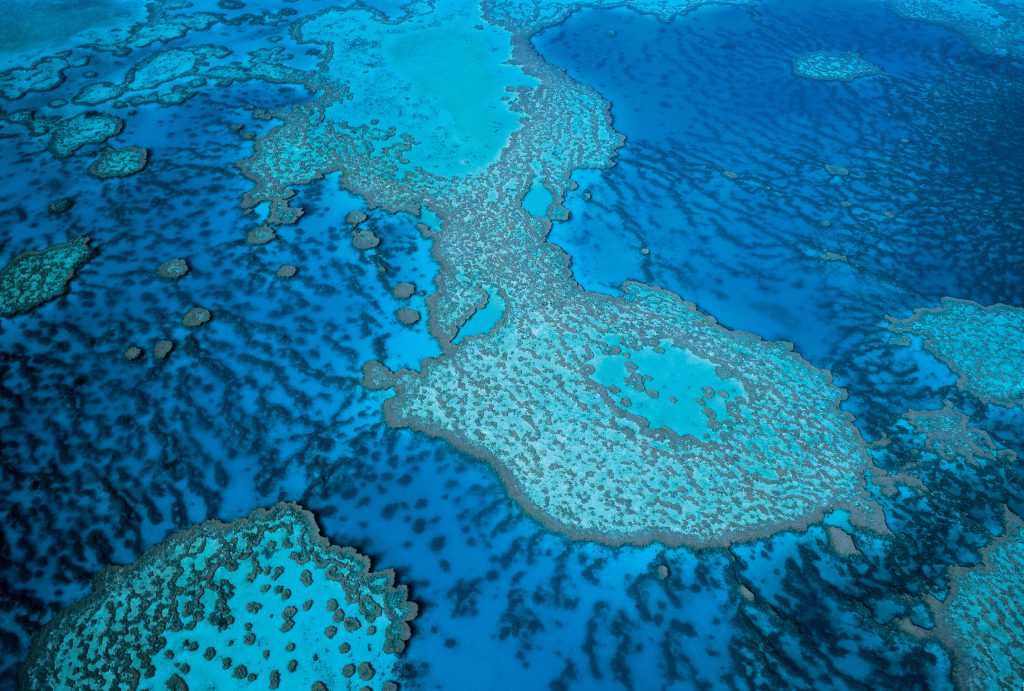
Photo: Tourism and Events Queensland
The overarching aim of this project was to provide the operational capability and capacity to guide RRAP’s quality decision making based on best available information from models and data, and against multiple objectives set by GBR stakeholders and rightsholders
This project encompassed the governance, design and construction of an Information System to support the RRAP modelling and decision support components. It ensured all necessary context for decisions made by RRAP projects could be captured, archived and accessed as required.
This project developed a set of guiding principles, models and analyses that could help to inform quality and priority decisions around RRAP interventions, in consideration of the multiple objectives of and benefits to diverse stakeholder, funder and rightsholder groups. Critical to this, the project supported and allow for informed, transparent, unbiased, inclusive, and timely decision making.
This project expanded on the capabilities of the ReefMod ecological restoration modelling tool. The project aimed to evaluate the benefits and success of restoration of a particular Reef area, by also modelling for the nutrient runoff impacts on algae and ocean acidification, and including a more appropriate model of coral genetic adaptation.
The eReefs and CoCoNet predictive models are helping to improve current management of GBR and into the future by mapping big data in near real-time. They provide a picture of what is happening across the entire living, connected ecosystem and predict future responses. This project expanded these capabilities to drive the models used in RRAP, e.g. improving ecosystem connectivity estimates, and incorporating coral disease susceptibility or natural adaptative capability.
This project focused on developing models that can support the decision-making around interventions that could be deployed on single reefs or reef sites. The project determined the costs and benefits of deployment at select sites within a reef, with consideration of coral age and growth rate and the environmental variation within a reef.
Stoeckl, N., Condie, S., & Anthony, K. (2021). Assessing changes to ecosystem service values at large geographic scale: A case study for Australia’s Great Barrier Reef. Ecosystem Services, 51, 101352. https://doi.org/10.1016/j.ecoser.2021.101352
Condie, S. A., Anthony, K. R. N., Babcock, R. C., Baird, M. E., Beeden, R., Fletcher, C. S., Gorton, R., Harrison, D., Hobday, A. J., Plagányi, É. E., & Westcott, D. A. (2021). Large-scale interventions may delay decline of the Great Barrier Reef. Royal Society Open Science, 8(4), 201296. https://doi.org/10.1098/rsos.201296
Richards, T. J., McGuigan, K., Aguirre, J. D., Humanes, A., Bozec, Y., Mumby, P. J., … & Riginos, C. (2023). Moving beyond heritability in the search for coral adaptive potential. Global Change Biology, 29(14), 3869-3882. https://doi.org/10.1111/gcb.16719
Pascoe, S., Anthony, K., Scheufele, G., & Pears, R. J. (2024). Identifying coral reef restoration objectives: A framework. Ocean & Coastal Management, 251, 107081. https://doi.org/10.1016/j.ocecoaman.2024.107081
Cresswell, A.K., Haller-Bull, V., Gonzalez-Rivero, M. et al. Capturing fine-scale coral dynamics with a metacommunity modelling framework. Sci Rep 14, 24733 (2024). https://doi.org/10.1038/s41598-024-73464-y
Yu, J., Baker, P., Cox, S. J., Petridis, R., Freebairn, A. C., Mirza, F., Thomas, L., Tickell, S., Lemon, D., & Rezvani, M. (2023). Provena: A provenance system for large distributed modelling and simulation workflows. In Proceedings of the 25th International Congress on Modelling and Simulation (MODSIM2023). Modelling and Simulation Society of Australia and New Zealand. https://mssanz.org.au/modsim2023/files/yu90.pdf
Crocker, R., Robson, B. J., Ani, C., Anthony, K., & Iwanaga, T. (2024). Synthetic data for reef modelling. Ecological Informatics, 82, 102698. https://doi.org/10.1016/j.ecoinf.2024.102698
Ani, C.J., Haller-Bull, V., Gilmour, J.P. et al. Connectivity modelling identifies sources and sinks of coral recruitment within reef clusters. Sci Rep 14, 13564 (2024). https://doi.org/10.1038/s41598-024-64388-8
Sun, C., Steinberg, C., Klein Salas, E., Mellin, C., Babcock, R. C., Schiller, A., Cantin, N. E., Stella, J. S., Baird, M. E., Condie, S. A., Hobday, A. J., Herzfeld, M., Jones, N. L., Zhang, X., Chamberlain, M. A., Fiedler, R., Green, C., & Steven, A. D. L. (2024). Climate refugia in the Great Barrier Reef may endure into the future. Science Advances, 10(48), eado6884. https://doi.org/10.1126/sciadv.ado6884
Stoeckl, N., Costanza, R., Dorji, N., Kubiszewski, I., Limenih, B., Tian, J., & Yamazaki, S. (2025). Valuing the reciprocating services that humans can provide to ecosystems. Ecological Indicators, 174, 113496. https://doi.org/10.1016/j.ecolind.2025.113496
Adam, A. A. S., Bozec, Y.-M., Hedley, J. D., & Mumby, P. J. (2025). Context-dependent benefits of coral reef restoration. Restoration Ecology, e70252. https://doi.org/10.1111/rec.70252
Adam, A. A. S., Bozec, Y.-M., Hedley, J. D., & Mumby, P. J. (2025). Context-dependent benefits of coral reef restoration. Restoration Ecology, e70252. https://doi.org/10.1111/rec.70252
Heneghan, R.F., Scheufele, G., Bozec, YM. et al. A framework to inform economic valuation of non-use benefits from coral reef intervention efforts. Coral Reefs (2026). https://doi.org/10.1007/s00338-026-02844-9
Sivapalan, M., Ortiz, J., Iwanaga, T., Yu, J., Mumby, P., Condie, S., Fitch, P., Whitt, A., Passaris, N., Marinovich, M. (2025) Reef Restoration and Adaptation Program – Management and Operations (M&DS-01) Final Report 2025. (19pp).
Bozec, Y-M., Adam, A., Bairos-Novak, K., Riginos, C. and Mumby, P. (2025) Reef Restoration and Adaptation Program – ReefMod R&D (M&DS-04) Final Report 2025. (33pp).
Ortiz, J. C., Creswell, A., Haller, V., Moore, J., and Lennon, D. (2025). Reef Restoration and Adaptation Program – Integrated Population Model Framework (IPMF) Research and Development (R&D) (M&DS-06) Final Report. (26pp).
| Title | Conference | Date |
|---|---|---|
| Meta-community modelling of the world’s largest coral reef system under extreme climate stress | Advances in Marine Ecosystem Modelling Research (AMEMR), Plymouth, United Kingdom | 2021 |
| Systems modelling to forecast climate impacts and evaluate intervention strategies on the Great Barrier Reef | 14th International Coral Reef Symposium (ICRS), Bremen, Germany | 2021 |
| A mechanistic model of the free-living and in hospite phases of zooxanthellae during a mass bleach event on the Great Barrier Reef | Australian Marine Sciences Association (AMSA) Conference, Cairns, Australia | 2022 |
| Changing the Climate Risk Trajectory for the Great Barrier Reef | Australian Marine Sciences Association (AMSA) Conference, Cairns, Australia | 2022 |
| Climate Refugia in the Great Barrier Reef Could Persist Into the Future | Australian Marine Sciences Association (AMSA) Conference, Cairns, Australia | 2022 |
| Extreme weather events mediate the capacity of reef building corals to adapt to increasing temperature | Australian Marine Sciences Association (AMSA) Conference, Cairns, Australia | 2022 |
| The value of guided intervention | 14th International Coral Reef Symposium (ICRS), Bremen, Germany | 2022 |
| The value of guided intervention | Reef Futures Symposium, Key Largo, United States of America | 2022 |
| The value of guided reef restoration and adaptation | Australian Marine Sciences Association (AMSA) Conference, Cairns, Australia | 2022 |
| A definitive measure of ‘social license to operate’ | EcoSummit, Gold Coast, Australia | 2023 |
| A provenance system for large distributed modelling and simulation workflows | 25th International Congress on Modelling and Simulation (MODSIM), Darwin, Australia | 2023 |
| Climate-driven zooplankton shifts cause large-scale declines in food quality for fish | Australian Marine Sciences Association (AMSA) Conference, Gold Coast, Australia | 2023 |
| Defining a biodiversity credit for coral reefs (Keynote) | Australian Marine Sciences Association (AMSA) Conference, Gold Coast, Australia | 2023 |
| Demographic and evolutionary responses of reef-building corals to climate change | Australian Marine Sciences Association (AMSA) Conference, Gold Coast, Australia | 2023 |
| Drivers of parrotfish feeding and bioerosion along an offshore reef slope on the Great Barrier Reef | 11th Indo-Pacific Fish Conference (IPFC), Auckland, New Zealand | 2023 |
| How to make static marine reserve networks work in a variable ocean | Australian Marine Sciences Association (AMSA) Conference, Gold Coast, Australia | 2023 |
| Modelling the influence of within-reef physical and environmental variability on coral spatiotemporal dynamics | Asia Pacific Coral Reef Symposium (APCRS), Nus, Singapore | 2023 |
| Allee effects and resilience of coral reefs during reproduction | Reef Futures Symposium, Quintana Roo, Mexico | 2024 |
| An integrated approach to modelling and decision support for coral reefs in the Anthropocene | Reef Resilience Symposium, Cairns, Australia | 2024 |
| Bridge building between adaptation research and coral models | Reef Resilience Symposium, Cairns, Australia | 2024 |
| Characterising the chronic and acute effects of temperature on the growth of Great Barrier Reef’s corals | Reef Resilience Symposium, Cairns, Australia | 2024 |
| Context-dependent benefits of reef restoration: a simulation-based analysis | Australian Coral Reef Society (ACRS) Conference, Perth, Australia | 2024 |
| Context-dependent benefits of reef restoration: a simulation-based analysis | Reef Resilience Symposium, Cairns, Australia | 2024 |
| C-scape: a within-reef metacommunity modelling framework to inform reef management in an uncertain future | Reef Resilience Symposium, Cairns, Australia | 2024 |
| Ecological heuristics for site selection to maximise survivorship and growth of deployed corals | Reef Resilience Symposium, Cairns, Australia | 2024 |
| Ecological projections of Australia’s Great Barrier Reef under an uncertain warming future | Reef Resilience Symposium, Cairns, Australia | 2024 |
| Enabling model and simulation provernance and data transparency with Provena | eReseatch Australasia, Melbourne | 2024 |
| Evaluation of models for decision support in a changing environment | Reef Resilience Symposium, Cairns, Australia | 2024 |
| Exploring future scenarios with time series clustering and SIRUS | iEMSS (International Environmental Modelling and Software Society), Michigan, United States of America | 2024 |
| Fate of climate refugia in the Great Barrier Reef | Reef Resilience Symposium, Cairns, Australia | 2024 |
| Interpretable rules for resilient reef futures with SIRUS | Reef Resilience Symposium, Cairns, Australia | 2024 |
| Location, Location, Location: Spatial considerations for managing reef resilience under uncertainty | iEMSS (International Environmental Modelling and Software Society), Michigan, United States of America | 2024 |
| Modelling the influence of conservation zoning on the Great Barrier Reef ecosystem | Advances in Marine Ecosystem Modelling Research (AMEMR), Plymouth, United Kingdom | 2024 |
| Mothership and tender routing with environmental constraints | Applied Mathematical Ecology Group Symposium (AMEG), Brisbane, Australia | 2024 |
| Panel Discussion: Key knowledge gaps for incorporating evolution/adaptation into reef forecast models | Reef Resilience Symposium, Cairns, Australia | 2024 |
| Plenary – How do we make smart decisions on where, when and how to intervene on coral reefs? | Reef Futures Global Symposium, Mexico | 2024 |
| Plenary- The future of coral reefs: bleak but responsive to interventions | Reef Futures Symposium, Quintana Roo, Mexico | 2024 |
| Reef-Risk: A decision support tool for identifying vulnerable and resilient areas in the Great Barrier Reef | Reef Resilience Symposium, Cairns, Australia | 2024 |
| RRAP Modelling and Decision Support Design report – a plan for design and implementation of decision support, | Reef Resilience Symposium, Cairns, Australia | 2024 |
| Synthetic data for exploring resilient reef futures | Reef Resilience Symposium, Cairns, Australia | 2024 |
| Synthetic Data for Reef Restoration Decision Support | iEMSS (International Environmental Modelling and Software Society), Michigan, United States of America | 2024 |
| The privilege of modelling for the GBR | iEMSS (International Environmental Modelling and Software Society), Michigan, United States of America | 2024 |
| Time Series Clustering for Decision Support | Applied Mathematical Ecology Group Symposium (AMEG), Brisbane, Australia | 2024 |
| Understanding within-reef variability with a coral metacommunity modelling framework | Australian Coral Reef Society (ACRS) Conference, Perth, Australia | 2024 |
| Unveiling spatio-temporal dynamics of the Great Barrier Reef using connectivity kernels | Advances in Marine Ecosystem Modelling Research (AMEMR), Plymouth, United Kingdom | 2024 |
| Validation of coral larvae connectivity modelling using observations of coral early life stages on the Great Barrier Reef | Reef Resilience Symposium, Cairns, Australia | 2024 |
| What can restoration offer the Great Barrier Reef? | Reef Futures Symposium, Quintana Roo, Mexico | 2024 |
| What is ‘fitness for purpose’ and how do you know when you have it?” | MSSANZ WQ Modelling Symposium, Queenstown, New Zealand | 2024 |
| Within-reef coral larval connectivity modelling identifies sources and sinks of coral recruitment in the Great Barrier Reef | iEMSS (International Environmental Modelling and Software Society), Michigan, United States of America | 2024 |
| Interpretable Sensitivity Analysis for Robust GBR Futures: A Shapley Effects Analysis on CoralBlox. | 26th International Congress on Modelling and Simulation 2025 | 2025 |
| Spatially explicit application of demographic models for six distinct coral groups on the Great Barrier Reef. | Australian Coral Reef Society Conference | 2025 |
| CoralBlox: A computationally efficient coral model for decision support. | Australian Coral Reef Society Conference 2025 | 2025 |
| Do androids dream of workflow provenance? An intelligent interface to the Provena metadata system. | MODSIM2025, 26th International Congress on Modelling and Simulation. Modelling and Simulation Society of Australia and New Zealand | 2025 |
| Maximising the benefits of local management for coral reefs amidst near-term environmental change. | Australian Coral Reef Society Conference | 2025 |
| Novel Risk Framework Informing Great Barrier Reef Adaptation Decisions. | Climate Adaptation 2025 Conference. | 2025 |
| Optimizing coral deployment for a mothership and multi-tender fleet. | Australian Coral Reef Society Conference 2025 | 2025 |
| ReefGuide: A Distributed Computing Platform for Identifying Candidate Coral Deployment Sites. | Australian Coral Reef Society Conference 2025 | 2025 |
| Sensitivity analysis of a local-scale coral larval connectivity model to biological parameters | 26th International Congress on Modelling and Simulation 2025 (MODSIM) | 2025 |
| Towards seamless provenance in collaborative modelling: Integrating Airflow with Provena | MODSIM2025, 26th International Congress on Modelling and Simulation. Modelling and Simulation Society of Australia and New Zealand | 2025 |
| Spatially explicit application of demographic models for six distinct coral groups on the Great Barrier Reef. International Congress on Conservation Biology | International Congress on Conservation Biology | 2025 |
| Coral reef resilience and the emergence of disruptive Allee effects. | Corals, Coasts and One Health, Nature Conferences, King Abdullah Of Science And Technology, Saudi Arabia | 2026 |

Scott Condie
CoCoNet Project Lead, CSIRO
Peter Fitch
Information Systems Lead, CSIRO

Peter Mumby
ReefMod Project Lead, UQ
Matthew Adams – UQ
Michael Bode – QUT
Yves-Marie Bozec – UQ
Anna Cresswell – AIMS
Ryan Heneghan – QUT
Sean Pascoe – CSIRO
Marji Puotinen – AIMS
Gabriela Scheufele – CSIRO
Matthew Simpson – QUT
Sharon Tickell – CSIRO
Jonathan Yu – CSIRO
Third-party roles in delivery will include collaboration with:
Adaptus
AIMS
CSIRO
Queensland University of Technology
University of Queensland
Numerical Optics
Dobes & Associates
R & Z Consulting
Social Ventures Australia